Total Views

Monday, June 10, 2024

Alchemy of Mediums

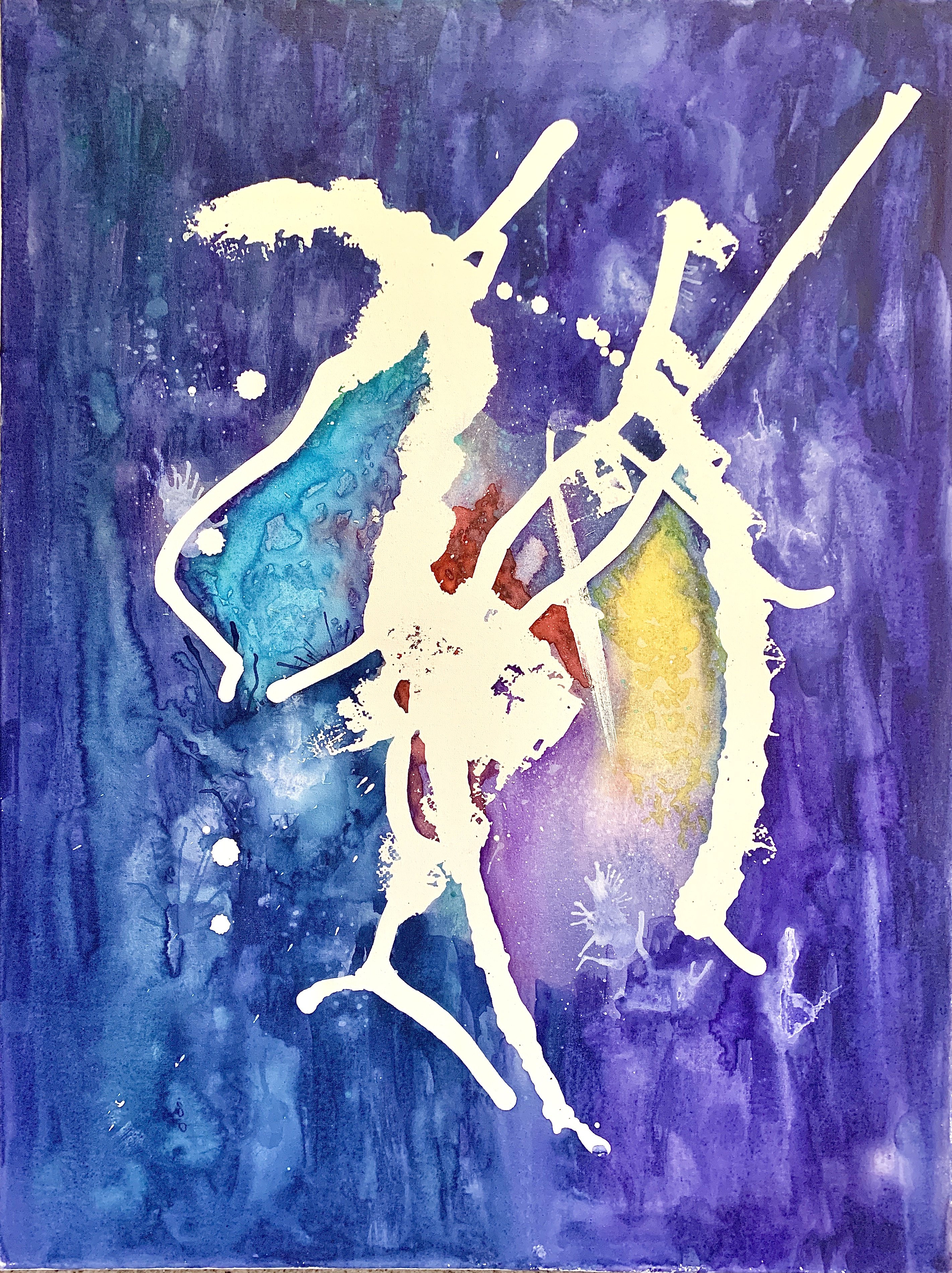
This piece was an exploration into the dynamic interplay of natural latex liquid, tube watercolor paint, and copper leaf sheets. With minimal prior experience in these mediums, I embarked on this experimental journey to observe their synergies and how they would manifest on the canvas.

Beginning with a delicate application of liquid latex, I allowed it to organically spread across the pristine white canvas, manipulating its flow through subtle tilts and controlled movements. Employing a straw, I introduced air currents to further animate the liquid, imbuing it with a sense of motion and vitality.

Once the latex had set, I applied tube watercolor paint, allowing its pigments to interact with the textured surface created by the latex. As the paint dried, I carefully peeled away sections of the latex, revealing intricate shapes and patterns beneath the rich hues of dark blue and purple. To enhance the visual complexity, I introduced vibrant tones of red, orange, and yellow, layering them to create depth and contrast.

Finally, to add a touch of opulence and intrigue, I adorned the center of the composition with delicate copper leaf, elevating the overall aesthetic and inviting further exploration of the piece's nuanced details.



Friday, June 7, 2024

Tranquil Reflections

I recently began this painting, set in the charming tourist town of Fontana, WI, located north of Illinois. It's progressing well but isn't finished yet; I'm still working on the tones. When I paint, I get into a zone where inspiration flows effortlessly. However, if I take a break from art and then return to it, I notice some rustiness, and it takes longer to get back into that creative zone.

The inspiration photo, with its bright tones of lemon green grass and an emerald-colored pond, presented a harmonious contrast against the dark brick-brown bark of the trees and the azure-lavender blue backdrop. I wanted to capture this stunning combination in my painting. The challenge is creating depth which I am still trying to figure out. 


Thursday, May 30, 2024

Eye Of The Dragon


I began painting rocks in 2021 during the pandemic. When the world went on lock-down and people were going stir crazy sitting at home; I was painting rocks. These small paintings actually were fast and fun. My young grandson’s thought they were cool too. So I was doing something right to keep their attention while having fun. After finishing our painting project; we took those rocks and placed them in playgrounds around the area.

Rock art is a fun craft to do outdoors or indoors. It also is a fantastic medium tool for those looking to practice painting in a crafty way. Great for gift giving, hiding in parks or along a hiking path to a passersby. 

Sometimes hiding rocks can be rough.
“Do I have to give up this rock, grams?”


Monday, May 27, 2024

Rock Out

What do rocks and art have in common? They can be hard, thrown, rough, smooth, deep, shallow, slick, and vary in shape, color, texture, style, dimension, and weight.

This painting came together as a study for a larger piece I had been working on at the time. Creating realistic-looking water is a challenge, but painting rocks in a stream of moving water is mind-bending for a novice.

The takeaway from this experiment in rock painting was that it was an interesting attempt that I actually liked, even though it did not turn out as intended. What I liked about this monochromatic project before adding color was how the rocks looked in depth. When adding color, the rocks gained a shiny texture by applying white to the edges. That small gesture made a big difference in the dimensional perspective. 


Sunday, May 26, 2024

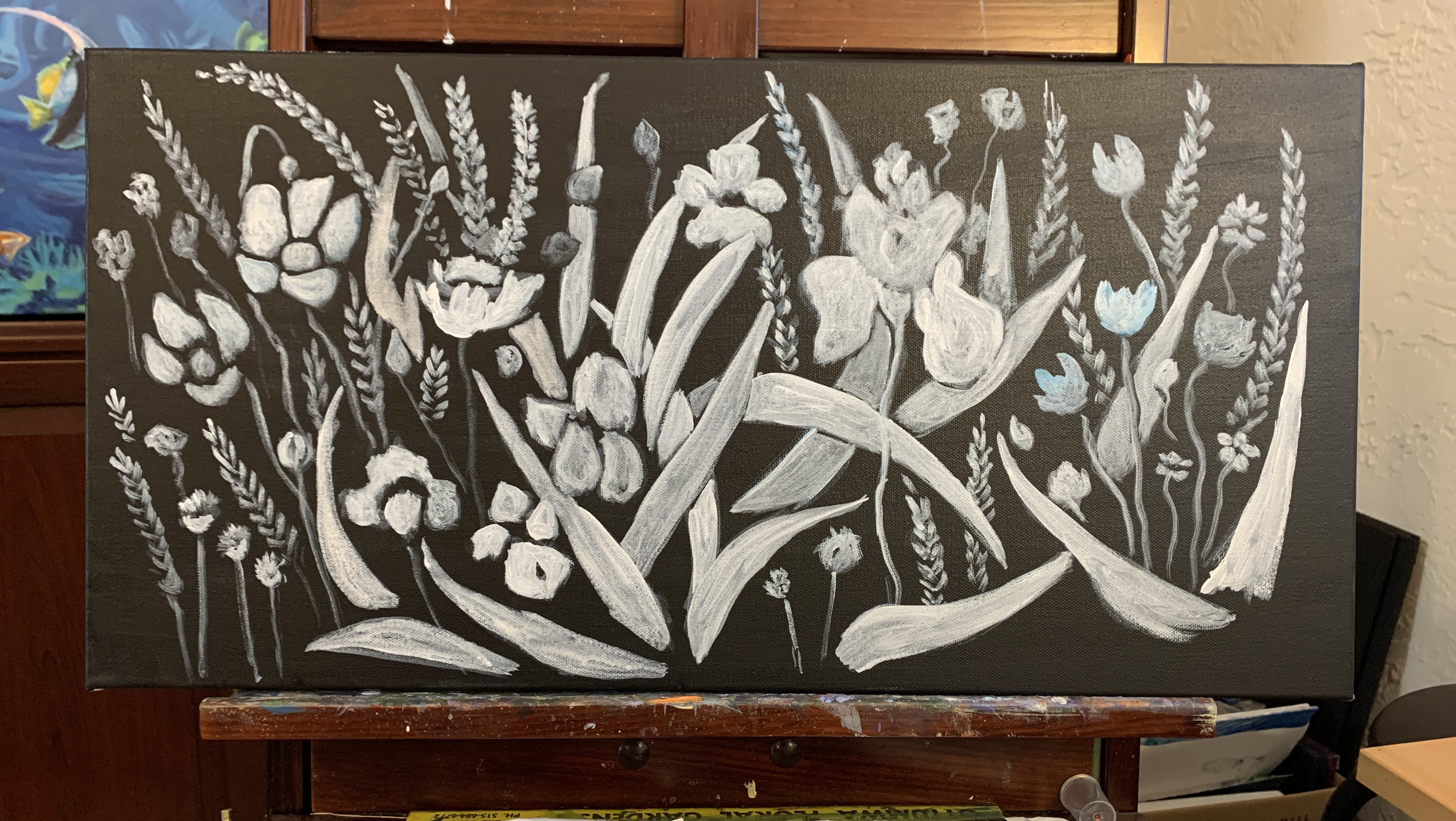
Dots and Flowers

The painting below was created using a concept similar to another piece I made, which was inspired by Van Gogh's "Irises" painting.

The technique came to me while looking at Aboriginal and mosaic art. The dots or rough shapes surrounding the main subject—in this case, the foliage, plants, and blooms—were placed randomly. I began with a black painted canvas, inserted white shapes, and then filled them in with color.

I classify these types of paintings as mindless abstract. Generally, after finishing more complicated work, I enjoy simply painting something that requires less thought, at least for me.


All those dots and unintentional shapes around the subject create a mood-enhancing calmness for me, simply through the repetitiveness of placing these shapes simultaneously.


For those interested in the origins of Aboriginal art, it was created by Australia's indigenous peoples. This art is characterized by dot painting, symbolic depictions, X-ray style showing internal details, and cross-hatching patterns. It conveys "Dreamtime" stories using natural materials like ochres and pigments on bark and rock, reflecting a deep connection to the land and often produced collaboratively.
To view Aboriginal style art click link. Aboriginal Art


Tuesday, May 14, 2024

Cloud Canvas

When driving through the countryside, a vast cloud cover stretched endlessly across the horizon, offering expansive views as far as the eye could see. The setting sun cast a golden glow that emerged from the depths of the cerulean blue sky, painting the road ahead with an enchanting aura that seemed to vanish into the infinite expanse.


In the cerulean sky so vast and wide,
Where cotton clouds like dreams do glide,
Their billowed shapes, a painter's delight,
Drifting softly in the sun's golden light.

Each cloud a story, ever-changing art,
Whispering secrets to the dreaming heart,
On wings of azure, they dance and play,
In the canvas of the endless day.

Oh, cerulean sky, with clouds so fair,
Reflecting moods in the open air,
Mysteries hidden in your depths so high,
Infinite tales written across your sky.


Monday, May 13, 2024

Van Gogh Inspired


One of my favorite artist, Van Gogh, who painted Irises is what inspired this painting. 


In the beginning, I created shapes surrounding the floral subject in a black and white mosaic like pattern. Then completed the painting with a similar color scheme of Van Gogh’s.


Historical, Vincent Van Gogh painted Irises in 1889 while living at the Saint-Paul-de-Mausole asylum in Saint-Rémy-de-Provence, France.
Van Gogh said the painting was "the lightning conductor for my illness" because he believed painting helped him avoid insanity. 
Van Gogh painted Irises from nature, capturing the irises' dramatic petals in the garden for the patients. The painting features a prominent white bloom among deep violet hues, with turquoise leaves forming a swirling band beneath the flowers. The painting's cropped composition and broad areas of vivid color are likely influenced by Japanese woodblock prints, which Van Gogh was a dedicated collector of. 
Van Gogh intended the irises to be purple, but the red pigment has faded over time, turning the flowers blue. He created a balanced background by dividing it into brown, purple, and green/yellow sections, which emphasizes the energy of the flowers and leaves. Van Gogh also made another still life painting of a bouquet, contrasting purple and pink with green. 
Irises is currently owned by the J. Paul Getty Museum in Malibu, California. In 1987, it became the most expensive painting ever sold, selling for $53.9 million to Alan Bond. Mr. Bond was unable to pay for the painting, and it was resold to the Getty Museum in 1990.


The Painting That Waited

Happy New Year! After a five-month hiatus, I’m thrilled to share what I’ve been working on since my last post in August 2025. Below is a pai...